Melbourne’s first ‘star theatre’
We celebrate the opening of the former H V McKay Planetarium 60 years ago this month on 2nd December 1965, in the former Institute for Applied Science in central Melbourne. Enjoy our illustrated special webpage:
It's Summer Solstice again
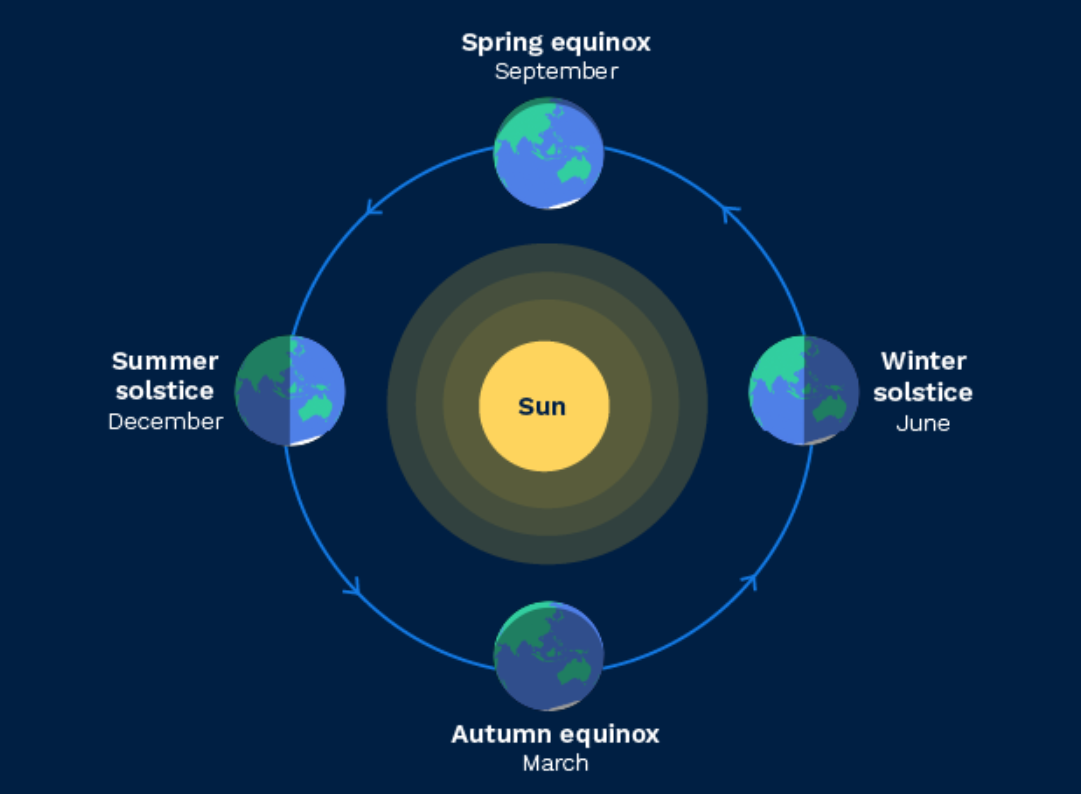
Earth will have its solstices this month on Thursday 21st - Summer Solstice in the Southern Hemisphere, Winter Solstice in the Northern Hemisphere. Solstice comes from the Latin meaning the standing still of the sun. This is when the path and position of the Sun in the sky reaches its furthest extremes and ‘pauses’ before beginning its six-month reverse to the next solstice.
At the summer solstice the Sun will rise and set at its most southerly points on the horizon. With Earth’s axis tilted at 23.5 degrees the southern hemisphere will be leaning towards the sun, its rays will be almost perpendicular giving maximum heat to oceans and land, the sun’s path will be the highest and longest of the year, and daylight hours will therefore be greatest.
The opposite conditions of winter will apply in the northern hemisphere where that hemisphere will be leaning away from the sun, sunlight will be at a shallow angle giving least warmth, the sun’s path will be low and short, and daylight hours will be the shortest of the year.
Explore:
Bureau of Meteorology – Solstices and Equinoxes
Timeanddate – December Solstice
Melbourne Sun times
| Date | Rise | Set | Day Length | Solar Noon* | |
| Monday 1st | 5:51am | 8:26pm | 14:34 hrs | 1:09pm | |
| Thursday 11th | 5:51am | 8:34pm | 14:44 hrs | 1:13pm | |
| Sunday 21st | 5:54am | 8:41pm | 14:47 hrs | 1:18pm | |
| Wednesday 31st | 6:00am | 8:45pm | 14:44 hrs | 1:23pm |
*When the sun is at its highest, crossing the meridian or local longitude.
Moon Phases
| Full Moon | Friday | 5th |
| Third Quarter | Friday | 12th |
| New Moon | Saturday | 20th |
| First Quarter | Sunday | 28th |
Moon Distance
Thursday 4th is lunar perigee (nearest to Earth) at 356,962 km.
Wednesday 17th is lunar apogee (furthest from Earth) at 406,322 km.
Planets
Mercury is moving closer to the Sun in the morning, but is not visible from Melbourne this month. However, in March it will reappear in the pre-dawn eastern skies.
Venus too is not visible from Melbourne as it heads to its pass behind the Sun, but will become visible again in April next year.
Mars will also move behind the Sun for its solar conjunction and not be seen from Melbourne in December. It will also return to our night skies in April.
Jupiter is visible in from just before midnight and will be a morning object moving in the north-east to north-werst until fading in dawn’s light around 5:30am.
Saturn, faint and yellowish, can be seen this month from around 9:15pm in the north-west before setting about 2am.
Meteors
This month, from the 4th–17th and peaking on the night of 13th/14th, the Gemini meteors will appear in the north-east. Unlike most meteor showers which occur as Earth passes through the trail of particles left by comets, the Geminids are associated with asteroid Phaethon. Up to 120 meteors per hour could be seen from dark locations.
Explore:
NASA - The Geminids
Timeanddate - Geminids
Stars and constellations
In the East
Summer offers a rich selection of features to enjoy from north-east to south-east.
Sirius, the principal star in the constellation Canis Major (Greater Dog), sits directly east in our evening skies. To the left is Orion (the hunter) with three bright stars forming a line as his belt. In our southern view, his two shoulders are Bellatrix at lower left and red-giant star Betelguese at lower right. His two feet are marked by Rigel at upper left and Saiph upper right.
Well known to many is the local asterism, The Saucepan. Being ‘right way up’ its base is Orion’s belt and its handle forms the hunter’s scabbard.
In the North
Taurus (the bull) can be seen by finding the red giant star Aldebaran which marks its red eye and is one corner of an inverted V which forms the bull’s head. At 65 light years away, Aldebaran is closer to us than the other stars that are at 150 light years and form an open cluster known as the Hyades.
To the left of Aldebaran is the beautiful Pleiades star cluster or Seven Sisters.
In many widely separated cultures this open cluster often represents a group of women, sometimes connected to the figure of a man as represented by the nearby stars of Orion.
In the West
in the south-west sits Sagittarius (the centaur-archer). Low in the west is Capricornus (the sea goat), and higher up is bright Formalhaut (Alpha Piscis Austrini) the principal star in Piscis Austrinus (Southern Fish).
In the South
Low in the south and upside down at this time of the year is Crux (Southern Cross) with the Pointers (Alpha and Beta Centauri) to its right guiding the eye to Crux. Our galaxy’s two small neighbouring galaxies, the Large and Small Magellanic Clouds, sit high in the south.
Stretching from south to north is the Milky Way’s dense arc of stars containing large interstellar dust clouds that block our visible light view of more distant stars, among them the Coal Sack that sits beside the Southern Cross.
Very close to the Beta Crux (the second brightest star in the Southern Cross) is the famous Jewel Box star cluster NGC 4755 – a popular telescope target. From dark locations It can be seen as a small fuzzy object with the naked eye.
International Space Station
ISS orbits every 90 minutes at an average distance of 400 km appearing like a bright star moving slowly across the night sky. Here are some of the brightest passes expected this month over Melbourne.
Evening
Saturday 6th 9:51pm-9:57pm North-North-West to East-South-East
Tuesday 9th 9:04pm-9:11pm North-West to South-East
Tuesday 23rd 10:49pm-10:52pm West-South-West to North-West
Wednesday 24th 10:00pm-10:05pm South-West to East-North-East
Heavens Above gives predictions for visible passes of space stations and major satellites, live sky views and 3D visualisations. Be sure to first enter your location under ‘Configuration’.
On this day
| 1st 1922 | The solutions to Einstein’s equations for space-time and mass-energy are developed by Alexander Friedman. |
| 2nd 1915 | Einstein’s General Relativity is published on gravity-acceleration equivalence and space-time curvature. |
| 2nd 1971 | Mars 3 (USSR) - first soft landing and return of data from Mars. |
| 3rd 2014 | JAXA explorer Hyabusa 2 (Japan) is launched to asteroid Ryugu with a planned sample return to Earth. |
| 3rd 1973 | The Pioneer 10 (USA) makes the first fly-by of Jupiter and returns the first close-up images of the planet. |
| 7th 1676 | The Danish astronomer Ole Remer calculates first accurate speed of light by observing eclipses of moon Io by Jupiter. |
| 7th-19th 1972 | The Apollo 17 (USA): last moon mission and longest on lunar surface at 74 hours, 59 mins by astronauts Eugene Cernan and Harrison Schmitt. |
| 7th 1995 | The Galileo probe (USA) makes first orbit of Jupiter after six years in transit. |
| 8th 1977 | The HEAO 1 (USA), High Energy Astro Observatory, is launched into orbit. |
| 8th 2010 | The SpaceX is first private company to launch, orbit and recover a spacecraft, its SpaceX Dragon. |
| 10th 1993 | The faulty optics of the Hubble Space Telescope (USA) are repaired. |
| 11th 1863 | The birth of astronomer Annie Jump Canon compiler of Draper Star Catalog. |
| 14th 1546 | The Danish astronomer Tycho Brahe, whose data aided Kepler in his laws of planetary motion, is born. |
| 14th 1962 | The Mariner 2 (USA) is first probe to fly past Venus. |
| 15th 1970 | The Venera 7 (USSR) is first probe to land safely on another planet, and first to return data, when it arrived at Venus. |
| 21st 1988 | The Cosmonauts Vladimir Titov and Musa Manarov make longest space flight (365 days, 22 hours, 39 min) on Soviet space station Mir. |
| 21st – 27th 1968 | The Apollo 8 (USA) first manned craft to orbit the Moon - 10 orbits at 110km from the surface, imaging landing sites and the iconic ‘Earthrise’ photo. |
| 24th 1979 | The ESA’s first launch vehicle Ariene 1 (France) orbits its first test satellite CAT1. |
| 27th 1571 | The discoverer of laws of planetary motion, Johannes Kepler, is born. |
| 28th 1612 | The Neptune is observed for the first time but mistaken as a star by Galileo. |
| 30th 1924 | The astronomer Edwin Hubble (USA) announces faint ‘nebulae’ are actually galaxies beyond our own. |